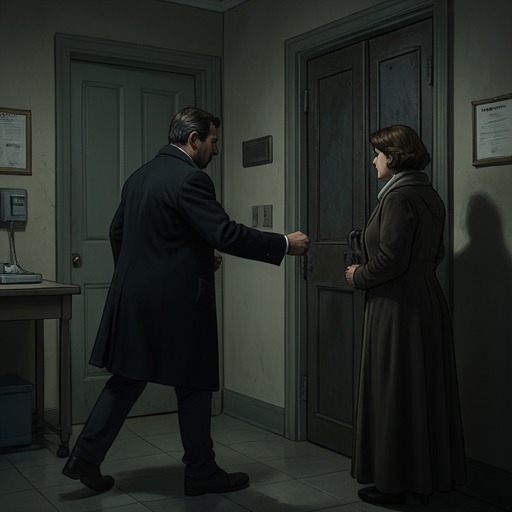
Richard’s funeral
After Ever HappyRichard Young’s funeral is a brief church service shaped by private grief, financial strain, and the gap between a dead man’s complicated life and the praise spoken over him. Tessa attends while struggling to comprehend her father’s fatal return to drug use; Hardin Scott, who paid for the funeral but wants the fact concealed, sits apart from her. The service gives neither of them an uncomplicated farewell: Tessa encounters public condolences that do not match what she knows of Richard, while Hardin’s presence sharpens his recognition of the damage he has done to her.
Arrangements and grief
Before the service, Tessa asks Carol who is paying for the funeral. She knows her mother cannot afford it and worries that Carol has taken responsibility for the expense to make a point to her church friends. Tessa also resents the black dress and high-heeled shoes Carol bought for her, believing they are purchases her mother cannot afford. Beneath these practical concerns is the more immediate dread of seeing her father buried.
Carol will not discuss the finances, and Tessa lets the exchange end rather than begin a fight on the day of the funeral. Her response is not indifference: she is numb, and she feels selfish for being unable to understand why Richard pushed one last needle into his vein despite knowing the danger. His death leaves her caught between the fact of his addiction and the incomprehensibility of his final act.
The financial question has an answer, though Carol does not give it. While staying at the Porter family home, Hardin tells Noah not to disclose that he paid for the funeral. Noah believes the payment gives Hardin a reason to attend, since he had been Richard’s friend, at least in some sense. Hardin resists the idea and insists that the payment remain secret. His assistance is therefore part of the event but not part of its public ritual: the person who covered the cost occupies no recognized role in the family’s mourning.
The service
Hardin sits in the back of a small church while Tessa, Carol, and Zed occupy the front rows with much of the congregation. He recalls that he had avoided attending his grandmother’s funeral, choosing drinking and a party over a farewell to someone he barely knew. He thinks he may never have attended a funeral before. His decision to be present for Richard is a sharp departure from that earlier avoidance, though he does not take a place beside Tessa at first.
The service is short. Tessa understands the church’s reluctance to celebrate the life of an addict as one reason for its brevity; the ceremony consists of a few stiff words and praises that feel false to her. Afterward, she moves through the mourners, offering thanks and accepting condolences. The repetition makes the social performance harder to bear: people call Richard a great man, but many of Carol’s church friends never met him. Tessa wonders what they have been told and resists both the congregation’s portrait and the expectation that she should affirm it.
Her objection is not a claim that Richard was a bad man. Tessa says she did not know him well enough to judge his character. What she can establish is the history between them: he left her and Carol when Tessa was a child, and only returned to her life a few months before his death, by chance. Their reconnection depended on Tessa being with Hardin at a tattoo parlor. The ceremony’s confident praise therefore presses against a history marked by absence and a relationship that had little time to become familiar.
Hardin’s place in the church
Hardin watches Zed sit beside Tessa, with Carol on her other side. He notices that Tessa seems somewhat more alive than she did earlier, although she still does not look like herself. He dislikes Zed’s closeness and cannot stop watching as Zed puts an arm around her, speaks quietly, and appears to calm her. Yet Hardin also accepts that Zed may be helping her through the day. His jealousy does not erase his awareness that Tessa needs support, even when that support comes from someone he resents.
When Karen smiles at Zed, he moves down and allows her to sit next to Tessa. The small shift changes the arrangement around Tessa without making Hardin the person she turns toward. The preacher begins, and Tessa gives no signal inviting Hardin nearer. He waits for some sign that she needs him, but the funeral does not give him the reassurance he wants. His physical presence in the church is not reconciliation, and his secret payment does not purchase access to her grief.
Recognition and aftermath
During the service, Hardin connects Richard’s death to the failure of his own plan to save Tessa by pushing her away. He understands that she had loved him, but that he repeatedly pressed her until she no longer wanted to continue the relationship. In his account, the imbalance is stark: Tessa helped heal his damage while he was breaking her spirit, and he recognizes that he knew he was hurting her without fully confronting what that meant. Her rejection made the harm impossible for him to keep overlooking; her father’s death gives that recognition a new urgency.
Hardin resolves to make things right with Tessa, not to repair every wrong in his life. That resolve remains one-sided at the funeral: Tessa does not beckon him, and he has to watch others comfort her. The scene holds care and injury together. Hardin has paid for Richard’s burial and come to mourn him, but the more consequential reckoning is with the living person he believes he has damaged.
For Tessa, the service offers no settled judgment of Richard and no neat public expression of grief. Its short prayers and repeated compliments contrast with the limited, accidental chance she had to know her father again. For Hardin, the church becomes a place of belated recognition rather than a simple act of mourning. The funeral’s significance lies in that divergence: the same ceremony exposes Tessa’s distance from the story others tell about Richard and Hardin’s dawning understanding of the distance his own actions have created.